

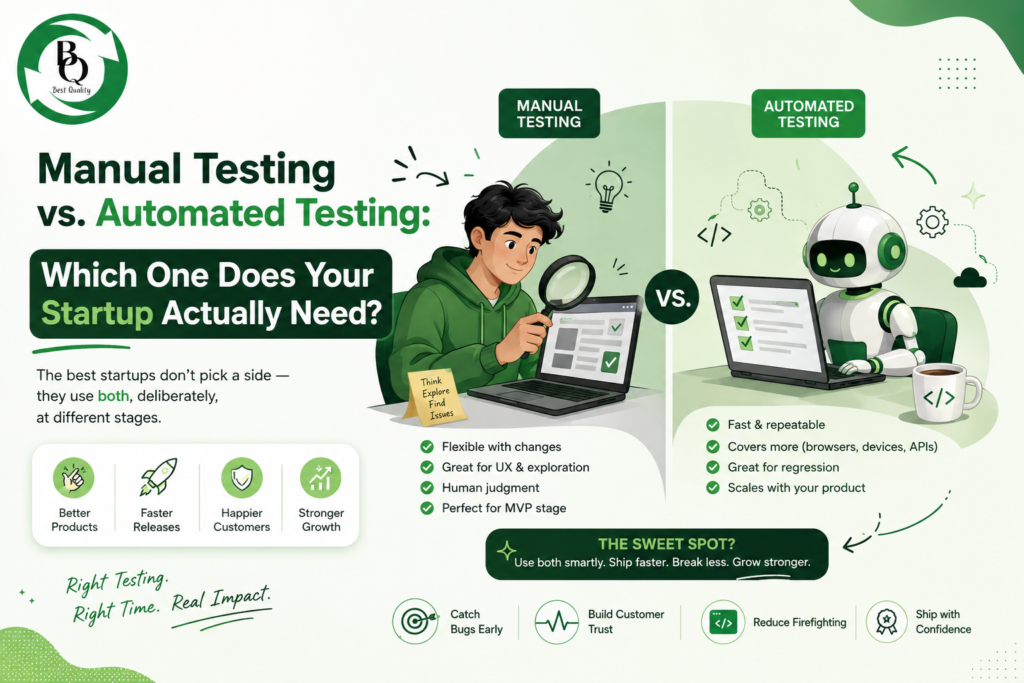
If you’re building a startup, every release feels like a race. Customers want features, investors expect velocity, and your engineers are heads-down shipping.
Sooner or later, one question lands on the table:
“Should we invest in test automation, or is manual testing enough?”
Here’s the honest answer: it’s the wrong question. The best startups don’t pick a side — they use both, deliberately, at different stages. What matters is knowing which one to lean on, and when.
Why This Decision Actually Matters
A bug caught during development takes minutes to fix. The same bug found by a paying customer costs hours of engineering time — plus a support ticket, a bad review, and a dent in trust you can’t easily measure. Industry research consistently puts the cost of fixing a production defect at several multiples of catching it early.
So testing isn’t overhead. It’s the difference between shipping fast and shipping fast twice — once to release, once to repair.
Where Manual Testing Wins
Manual testing gets dismissed as “old school,” but for early-stage products it’s often the smarter investment. It excels when:
1. Features are still changing weekly. Writing automation scripts for a feature that gets redesigned every sprint is wasted effort — you’ll spend more time maintaining tests than writing them. Manual testing flexes with the product.
2. User experience is the product. Automation can verify that a button works. It can’t tell you the button is in the wrong place, the flow feels confusing, or the copy reads awkwardly. Navigation, UI consistency, accessibility, overall feel — this is human-judgment territory, and it stays that way.
3. You need exploratory testing. The nastiest bugs are rarely in your test plan. A skilled QA engineer poking at the product in unexpected ways — weird inputs, interrupted flows, back-button abuse — finds issues no script was written to catch.
4. You’re still validating product-market fit. If the feature might not exist in three months, automating it is premature optimization. At MVP stage, speed of learning beats depth of coverage.
Where Automation Pays For Itself
As the product stabilizes and the release count climbs, the math flips. Automation earns its keep on:
1. Regression testing. Every new feature risks breaking three old ones. Re-running the same 200 checks by hand before each release burns days; an automated suite does it in minutes, every time, without getting bored and missing step 147.
2. Release velocity. Teams deploying weekly — or daily — simply cannot gate every release on manual passes. Automation is what makes continuous delivery real instead of aspirational.
3. Coverage you can’t do by hand. Five browsers × four devices × three OS versions × dozens of API combinations. No manual team covers that matrix affordably. Machines do it overnight.
4. Long-term cost. Automation has an upfront cost, no question. But it’s a one-time investment against a recurring expense. The bigger your app gets, the better the ROI — repetitive manual regression is the most expensive way to buy the same information twice
Three Myths Worth Killing
Myth 1: “Automation replaces QA engineers.” Automation executes what someone already thought to check. QA engineers decide what’s worth checking — they think like customers, hunt edge cases, and question assumptions. Automation amplifies good testers; it doesn’t replace them.
Myth 2: “Serious startups automate everything.” Automate high-risk functionality, money paths, and stable, frequently-used workflows. Leave rapidly changing features alone until they settle. Automating churn-prone UI is how teams end up with a test suite nobody trusts and everybody skips.
Myth 3: “Automation is an enterprise thing.” Open-source frameworks (Playwright, Selenium, Cypress) and cloud device farms have collapsed the entry cost. The real threshold isn’t company size — it’s whether your product is stable enough that the same tests run repeatedly.
When Should Your Startup Start Automating?
Watch for these signals:
- Manual regression before each release now takes days, not hours
- The same test cases repeat every single sprint
- Release dates slip because “testing isn’t done”
- Production bugs are trending up, not down
- Engineers spend mornings firefighting instead of building
Two or more of these? The repetition tax has arrived, and automation is how you stop paying it.
A Phased Approach That Actually Works
Stage 1 — MVP: All manual. Test the money paths (signup, payment, core workflow) before every release. Optimize for learning speed.
Stage 2 — Growth: Automate regression on stable features. Keep manual testing for new features, UX, and exploration. This is also the stage where many startups bring in outside QA capacity — a fractional or outsourced team can build the first automation suite and run structured manual testing without the cost or lead time of hiring in-house.
Stage 3 — Scale: Automate critical user journeys end-to-end, wire tests into CI/CD so nothing ships without a green run, and keep human testers focused where they’re irreplaceable: usability, edge cases, exploration.
The Bottom Line
Manual and automated testing aren’t competitors. Manual testing helps you build the right product. Automation helps you build it reliably, at scale.
The goal was never “automate everything.” It’s automating what delivers the highest return while keeping human judgment where it matters most. The teams that scale smoothly are the ones that get that balance right — and revisit it as the product grows.
What’s working for your team — manual, automation, or a mix? Share your experience in the comments; I’d love to compare notes.